In the summer of 2020, The Funambulist Podcast recorded a series on France’s “quartiers populaires.” These episodes were often recorded in the neighborhoods being discussed, where the host, Léopold Lambert, interviewed current and former residents. Les Potagers, a housing project in Nanterre, is the subject of two such episodes. Built in the early 60’s, Les Potagers was originally intended to be a transitory housing complex. At the time of recording the podcast, in September 2020, Les Potagers had been in use for over 60 years. Nanterre, often described as “a small piece of Algeria” on the outskirts of Paris, was a site of great unrest during the Algerian war for independence.
Mogniss Abdallah, Mabrouka Lahbaïri, Belkacem Lahbaïri, Boubakar Mazari and Cherif Cherfi recount their time as residents of Les Potagers. With only about 69 families, it was a tight community. Anecdotes of concerts, weddings, Eïd celebrations and police confrontations map out their neighborhood bringing it to life on the eve of its demolition. Their surroundings animate the stories they tell; Belkacem points out the chimney where all the dads hung out in the winter. His sister Mabrouka describes the chestnut trees, how much they’ve grown in the 60 years she’s been a resident. Something that kept coming back over and over again was the infamous door to Les Potagers. The door was the only way in and out of the housing project. There was one key. As they recount their teenage techniques of bypassing the door, they chuckle. Belkacem, when talking about Les Potagers’ imminent demolition, even suggests the door should be kept as a trace of the neighborhood. In the same breath, he tells us about the numerous police sieges on the neighborhood, and how the door, being the only point of entry/exit, was easily blocked off by police forces.
I was curious. What did this door look like? Could it be climbed over?
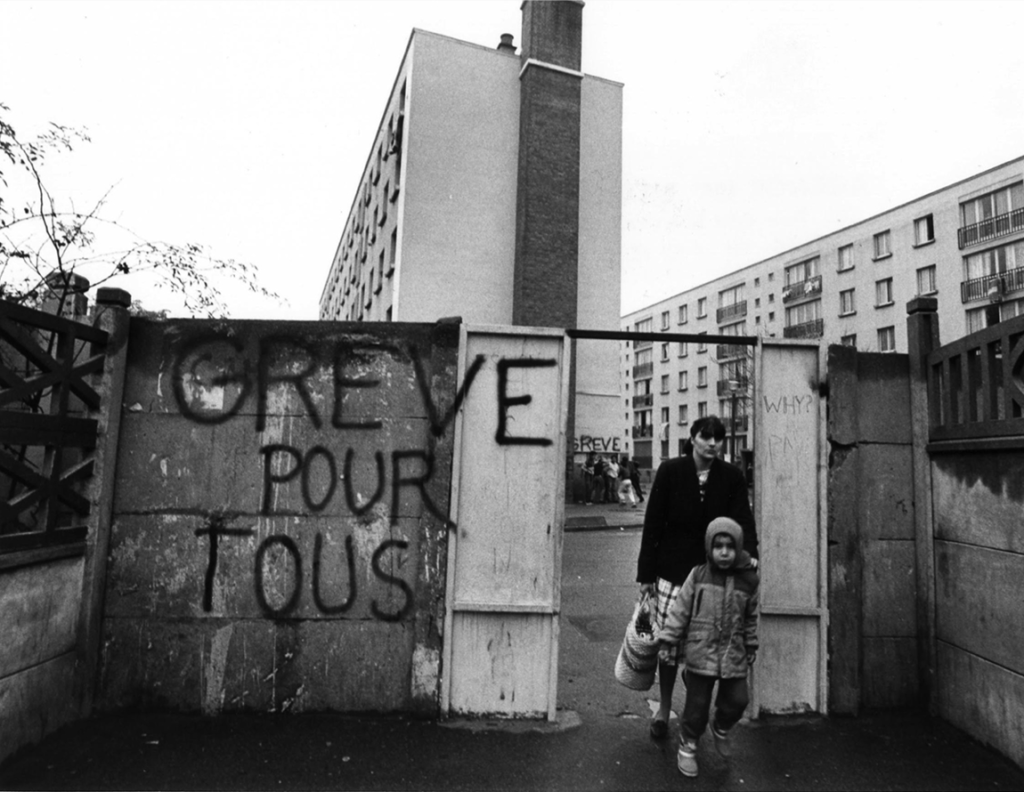
In 1987 Belkacem Lahbaïri produced a documentary about his neighborhood, Autopsie d’une Cité. In the documentary the door appears several times, as something quotidian, something functional. It is a passageway. But, the very purpose of a door is that it can be closed.
Points of entry, doorways, openings, wounds… In colonial Algeria, France looked for points of entry, for a way in, for doorways they could open and subsequently shut. There is something fleshly about this search, something carnal about finding points of entry. On the cusp of the Algerian war for independence the colonial government identified women as that doorway, their emancipation a kind of opening their assimilation a kind of shutting. But what if the door can’t be shut? What if these women, supposedly France’s way in, howl in protest? What if they place bombs in cafés? What if the “door” can be strategically opened and closed? Les Potagers’ teenagers found ways around the door. They scaled walls in protest: they found alternative points of exit.
